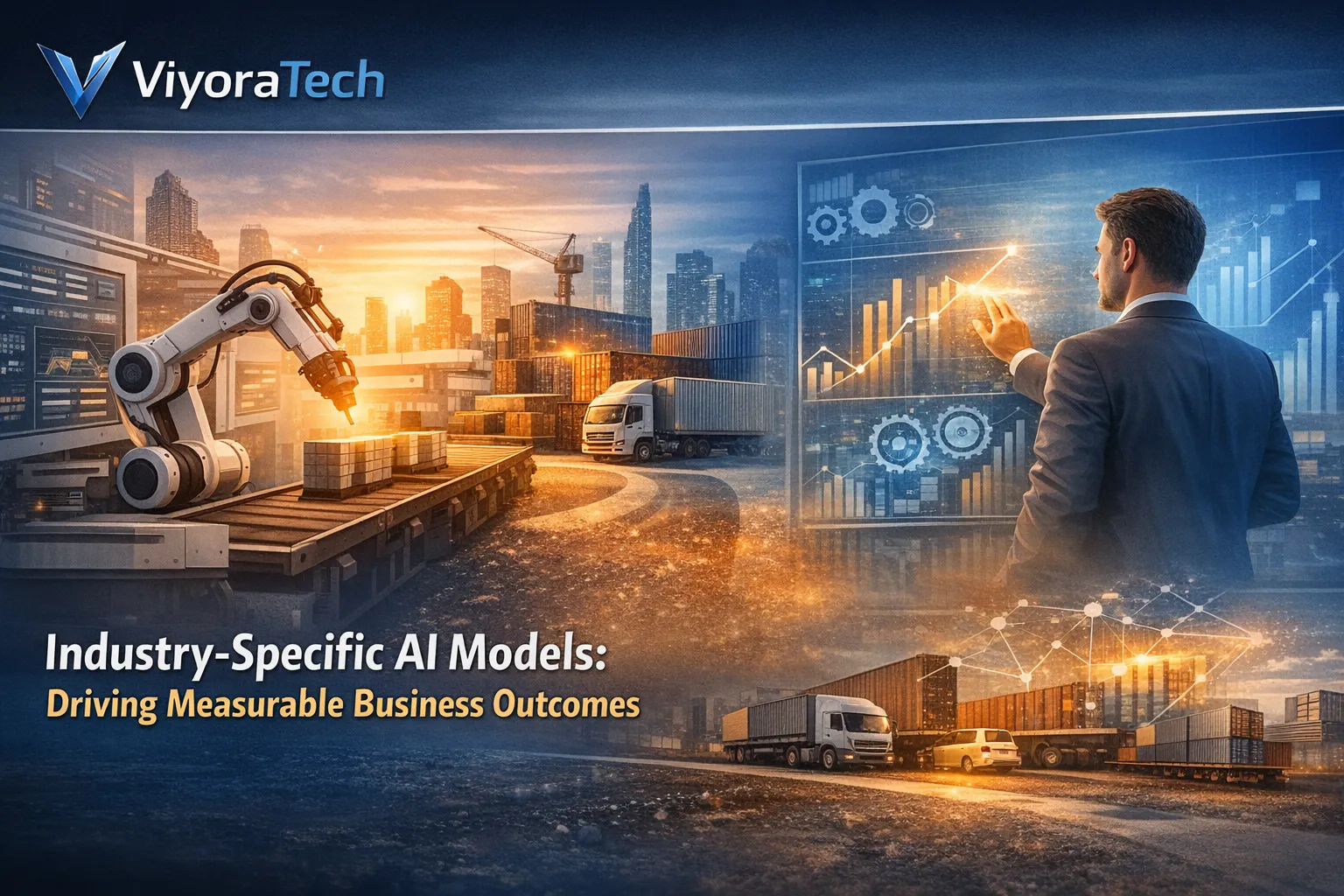
Industry-Specific AI Models: Practical Use Cases for Business Leaders
Industry-specific AI models are transforming how manufacturers and enterprise businesses operate by delivering precision, predictability, and performance improvement. Unlike generic AI systems, domain-focused models are trained to understand sector-specific processes, risks, and compliance requirements. From predictive maintenance and AI-powered quality inspection to intelligent supply chain optimization and fraud detection, specialized AI enables organizations to reduce operational costs, minimize risk, and improve revenue performance. ViyoraTech partners with business owners and manufacturers to design, implement, and continuously optimize industry-tailored AI solutions that integrate directly into existing workflows and ERP systems—ensuring measurable ROI and long-term competitive advantage.
How ViyoraTech Enables Measurable ROI Across Manufacturing & Enterprise Operations
Executive Overview
Industry-specific AI is transforming how modern businesses operate. Unlike general-purpose AI systems, domain-trained models are engineered to understand sector-specific terminology, regulatory constraints, operational workflows, and risk structures.
For manufacturers, distributors, and enterprise leaders, this shift means one thing:
AI is no longer experimental — it is a strategic tool for measurable business performance improvement.
ViyoraTech specializes in designing and deploying AI systems tailored to industry realities, ensuring business impact rather than theoretical innovation.
The Strategic Shift: From Generic AI to Industry Intelligence
General AI models offer broad capabilities. However, industries such as manufacturing, logistics, finance, and retail require:
- Operational precision
- Regulatory compliance
- Context-aware decision-making
- High-cost error mitigation
A defect in a manufacturing unit is not equivalent to fraud in finance. Demand volatility in retail behaves differently from supply chain disruption in heavy industry.
Specialization outperforms generalization when the domain is well-defined and financially significant.
Manufacturing: Predictive, Preventive, and Performance-Driven
1. Predictive Maintenance
Unplanned downtime is one of the most expensive operational risks in manufacturing.
AI-driven predictive maintenance analyzes:
- Vibration patterns
- Temperature drift
- Pressure fluctuations
- Acoustic signatures
- Historical service logs
Business Value
| Traditional Maintenance | AI-Powered Maintenance |
|---|---|
| Reactive repairs | Proactive intervention |
| Sudden equipment failure | Scheduled maintenance |
| High spare inventory | Optimized parts planning |
| Production losses | Stable throughput |
ViyoraTech Implementation
- IoT sensor integration
- Custom ML models trained on plant data
- Real-time dashboards for plant managers
- ERP and maintenance system integration
- Continuous retraining pipeline
2. AI-Based Quality Inspection
Manual inspection is:
- Time-consuming
- Subjective
- Limited to sampling
AI computer vision systems inspect 100% of production output in real-time.
Applications
- Surface crack detection
- Weld inspection
- Packaging defects
- Alignment validation
- Micro-defect detection
Business Benefits
- Reduced rework and scrap
- Lower warranty claims
- Higher product consistency
- Stronger brand reputation
ViyoraTech builds vision systems trained on your historical defect data, ensuring relevance and precision for your manufacturing environment.
3. Intelligent Supply Chain Optimization
Supply chain volatility directly impacts cash flow and operational stability.
AI models help answer:
- How much inventory should be stocked?
- Which supplier poses risk?
- What is the optimal production schedule?
- Where are bottlenecks forming?
Business Impact
- Reduced inventory carrying cost
- Improved On-Time In-Full (OTIF) performance
- Lower stockouts
- Better working capital efficiency
ViyoraTech integrates forecasting engines directly into ERP systems to enable execution, not just analytics.
Finance & Enterprise Risk: Intelligent Monitoring at Scale
4. Fraud Detection & Anomaly Monitoring
AI models identify transactional irregularities such as:
- Behavioral deviation
- Velocity anomalies
- Geographic inconsistencies
- Device changes
Business Outcomes
- Reduced fraud loss
- Lower false positives
- Stronger compliance posture
- Improved customer trust
ViyoraTech designs explainable AI systems with audit-ready reporting for regulatory environments.
Retail & Distribution: Revenue and Margin Optimization
5. Demand Forecasting & Dynamic Pricing
AI-driven systems analyze:
- Historical sales
- Seasonal patterns
- Market signals
- Competitive pricing
- Consumer behavior
Measurable Results
- Increased revenue
- Improved margin control
- Reduced dead inventory
- Higher conversion rates
ViyoraTech builds demand forecasting and pricing intelligence engines tailored to each organization’s supply network and customer base.
Why Industry-Specific Models Matter for Business Owners
1. Domain Accuracy
Industry-trained models understand:
- Operational terminology
- Edge cases
- Regulatory requirements
- Historical production patterns
2. Direct ROI Alignment
AI must impact core KPIs:
| Industry | KPI Impact |
|---|---|
| Manufacturing | Downtime ↓, Defects ↓, Yield ↑ |
| Retail | Conversion ↑, Stockouts ↓ |
| Finance | Fraud Loss ↓, Risk Accuracy ↑ |
| Distribution | Working Capital Optimization |
3. Governance & Explainability
Enterprise leaders require:
- Transparent model decisions
- Audit trails
- Performance monitoring
- Drift detection
ViyoraTech embeds governance into every deployment.
ViyoraTech Industry AI Implementation Framework
Step 1: Business Impact Identification
Define high-value, measurable use cases.
Step 2: Data Readiness Assessment
Evaluate quality, availability, and integration maturity.
Step 3: Custom Model Development
Build domain-trained AI aligned with operational constraints.
Step 4: Workflow Integration
Embed models into ERP, CRM, and production systems.
Step 5: Continuous Optimization
Deploy → Monitor → Feedback → Retrain → Improve
Executive Conclusion
Industry-specific AI models are becoming essential for competitive organizations. Businesses that implement domain-focused AI solutions:
- Operate with predictive intelligence
- Reduce operational inefficiencies
- Increase decision velocity
- Strengthen market positioning
ViyoraTech partners with business owners and manufacturers to transform operational data into measurable business advantage.
ViyoraTech
Engineering Intelligent Industry Solutions for Modern Enterprises